

Food is... joy.
Join me as I weave together memories of mango seasons from near and far.

Hello again. For those of you who are new to this Subtstack, welcome. I’m easing into writing on this platform with a series of ‘Food is…’ posts, exploring what food means to me beyond its nutritional value. I don’t know yet whether I “live to eat” or “eat to live” but so far I’ve written about why I started this Substack, about a noodle dish transported through fragments of memory, and why New Year in Kerala starts in April.
Today’s post was inspired by Amma’s (my mother’s) recent trip to Kerala, where she spent a few precious weeks with her own Amma (my Ammamma, my Gran), indulging in mango season whilst trying to stay cool during a blistering heatwave.
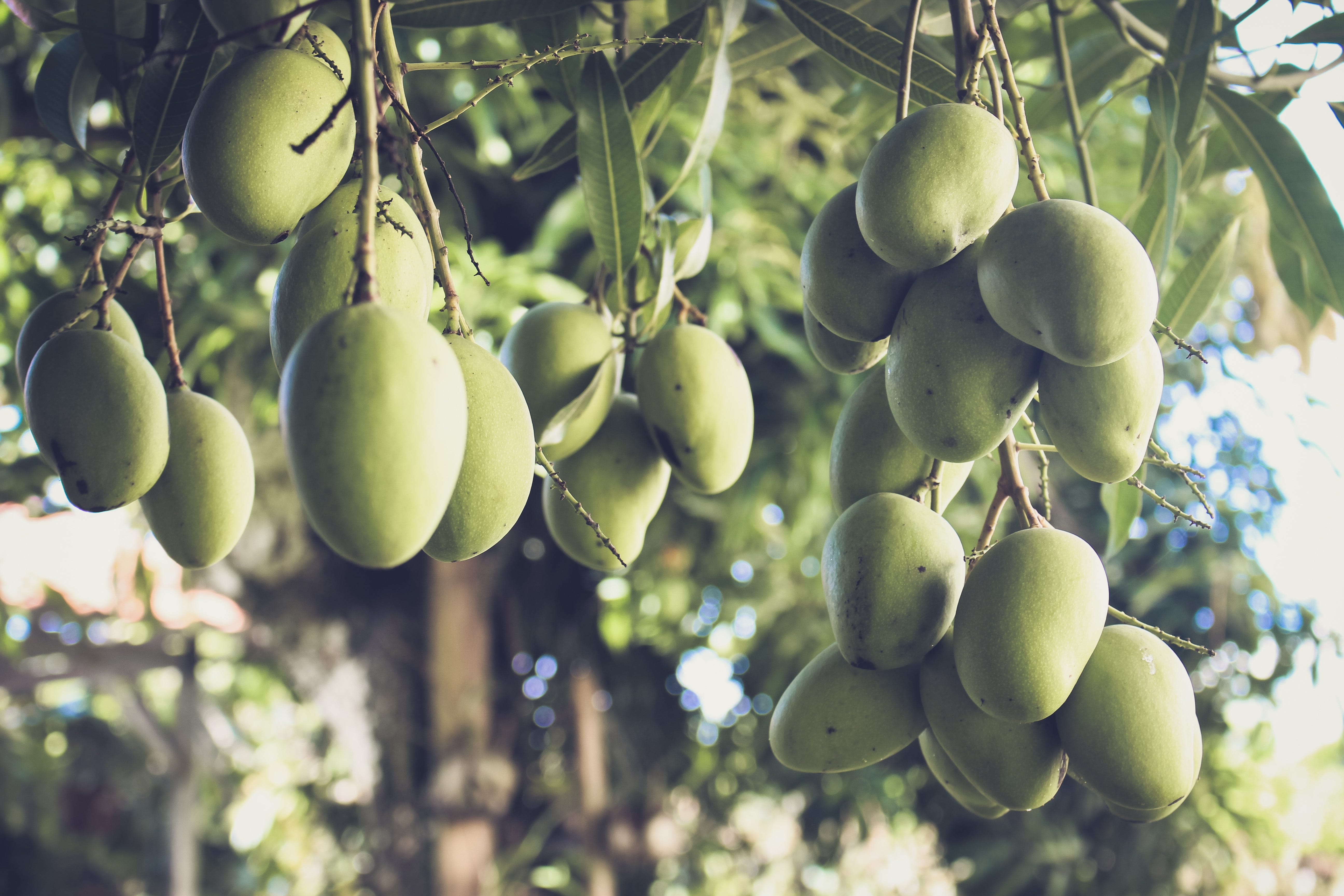
Misty-Eyed Memories
If you are a parent with children in school, chances are that you already know how much the school calendar (and consequently workplace dynamics) dictates when you get to take a holiday. For a Malayali with strong ties to Kerala, this means the vast majority of trips to India are likely to happen between July to August, which coincides with the rainy season/monsoon (though still offering much longer spells of sunshine and summer than Britain). Easter and Christmas are also popular times of the year to travel. Crucially, what these holidays have in common is that they frog leap over the precious mango season that occurs between March and June, peaking in April and May. Amma’s job working in a nursery meant she continued to visit Kerala only during British summertime, many (many) moons after my sister and I left school.
This year, however, Amma enjoyed mangoes at her home in Kollam, Kerala for the first time in over 40 years. The first time since 1979 when she left Kerala’s coconut tree-lined coastline for the colder climes of Blighty. That’s a very long time to go without the mangoes that coloured her childhood with honey-sweet hues of yellow, green, and red.
When my sister and I were children, oh how Amma would wax lyrical about the ‘Ottu’ mangoes she would pick directly from the trees in her home. She recollected how unique their flavour was and how their mango trees drew in neighbouring admirers for the fruit. Amma always shook her head in amazement as she recounted her childhood stories, which were often triggered by slicing up the tough skin of supermarket varieties of mangoes that were hard and green on the outside tinged with an embarrassed blush of red. My father’s eyes would widen as he told his own stories of the many more varieties of mangoes he enjoyed in his youth, beaming with the residual joy from years gone by, using his hands to show us the size and shape of the mangoes he encountered. I still marvel at the mangoes he claimed were as big as dinner plates and wonder just how much the mangoes grew in size in his memory with each iteration. Amma never tried to outdo my father’s memories because this way they could each preserve their own joys, untainted and untouched by jealousy.
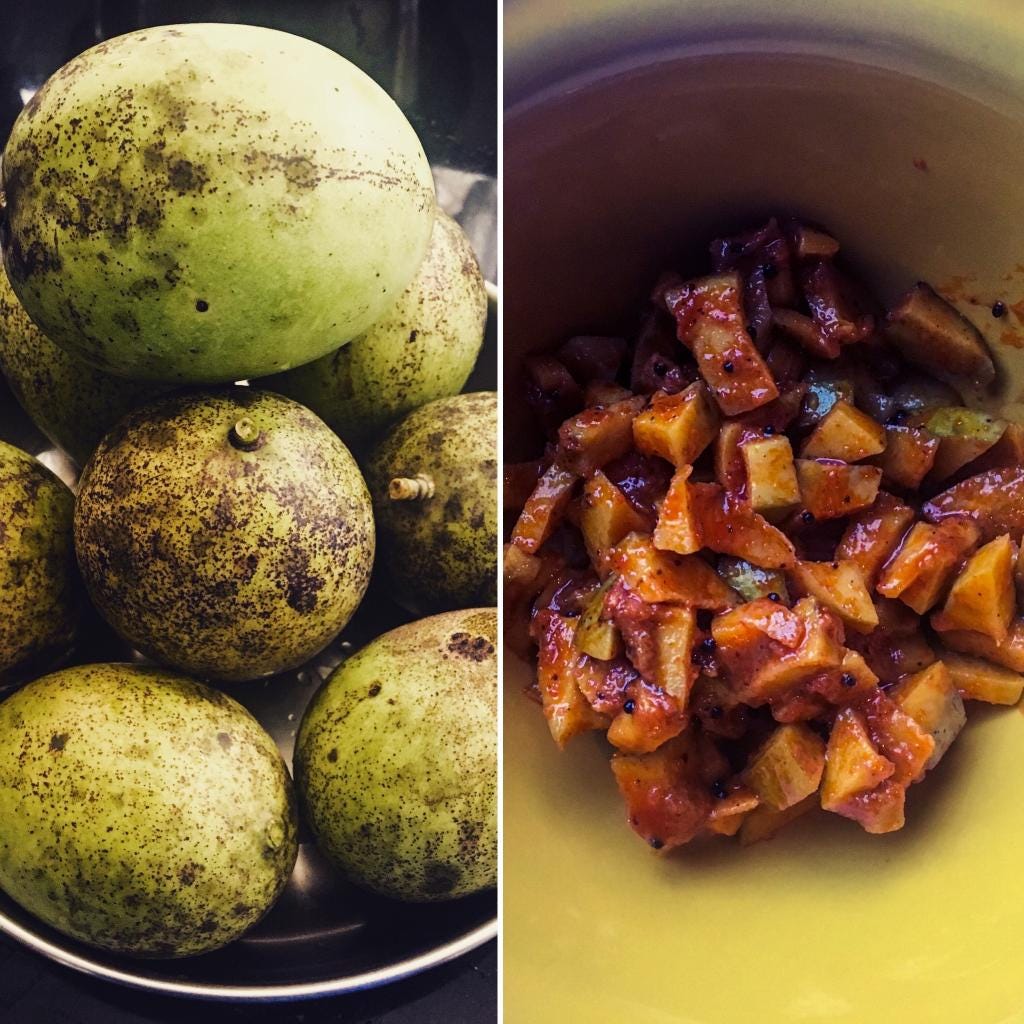
Both Amma and my father had a very unusual thing in common when it came to mangoes. So much had they indulged in mangoes in their childhood, they would rarely eat mangoes purchased from anywhere on the British high street. The common refrain would be ‘I’ve eaten more than my fill for a lifetime when I was a child. It’s your turn to enjoy’. Beyond the misty-eyed parental love, it seemed like the mangoes sitting in the bowl in front of them could never come close to the experience of their childhood. To be fair, I’m not surprised.
“Who wants a sour, crunchy mango anyway?”
Supermarkets in the UK generally sell either the ‘Kent’ or the ‘Tommy Atkins’ varieties of mangoes, both of which originate in Florida but are now harvested primarily from areas of South America. Resistant to disease, long shelf life, and ease of transportability have helped to establish these varieties almost all year round on supermarket shelves. You might find me, during a moment of Winter-induced madness, skulking around the mango aisle trying to find a mango that’s just crossed over to the bad side of ripe because only this level of ripeness will give me even a hint of the mango flavour I long for. A weird sort of mango roulette is in play if you happen to eat a mango that’s too far gone and imparts an unpleasant zing on the tongue. Who wants a sour, crunchy mango anyway? The supermarket varieties are either too sweet to pickle or too sour to enjoy like the Indian or Pakistani mangoes I learned to love and adore.
From late April to July every year, many households around the UK will enjoy an imported mango season. Every Asian grocer worth their salt anywhere in the UK will be selling boxes of mangoes from the Motherland. Boxes and boxes of Indian and Pakistani Alphonso, Kesar, Badami, Chaunsa mangoes will arrive, mostly bought wholesale in New Spitalfields Market in East London, to fill the fronts of Asian grocery stores for a precious few months, mostly disappearing by July. Mango sales have reportedly dropped in the current cost of living crisis, and the cost of fuel has driven up the prices of mangoes significantly. However, if the constant buzz of activity at Sakthi Cash & Carry in Gants Hill is to be believed, you still need to be up bright and early if you want a box (or two) of ‘fresh’ Alphonso mangoes.
A Private Affair
A few days ago, I came home with a box of Mingolo mangoes, harvested in the Dominican Republic. Seeing my disappointment of missing out on the Alphonso, I was steadfastly assured by the cashier that Mingolos were among the fastest ‘moving’ stock they had. As I mulled it over, I detected a heady Kesar-like honey scent wafting through the cardboard and I gave in.
I’d like to imagine that I wasn’t the only one yesterday who stood by the kitchen sink chewing on a juicy mango seed after slicing up a couple of mangoes from this precious cargo for the folks at home. It almost goes without saying that the mango seed ought to be enjoyed alone. It’s a salacious endeavour, and all manners must be left by the wayside during this time. Passers-by, please avert your eyes. Mango juice trickled and dripped down my arm as I extracted all of the sweet fruit from the husk of the seed, its fibre getting caught between my teeth, and cheeks streaked with misplaced mango nectar. Not that I cared at that moment as I was too engrossed in savouring the rush of honey-sweet flavours from my all too generously cut mango seed. The mango seed is always the preserve of the person cutting the mango, and it’s their prerogative to leave as much or as little flesh on it to be enjoyed later. Wouldn’t you agree?
From Mango Trees to Orchards
Plucking mangoes straight from the tree is a common feature of golden-hour filtered memories of my parent’s childhood. With this in mind, Amma made sure to fill the long and narrow garden of our Victorian terraced home with enough trees to (possibly) qualify as an orchard! The queen of them all was our cherry tree. Big, juicy orbs of Stella cherries were the highlight of our summers, our clothes splashed with purple stains as we plucked and ate cherries directly from the tree. We would gather enough fruit to share a carrier bag full with our neighbours and still have plenty to go around for aunts, uncles, and cousins. The branches grew big and strong, upon which our childhood memories sat happily, even if for the briefest of moments. Sumptuous, nectar-filled greengages, tart green apples eaten with chili powder and salt (try it!), purple plums, and floral-flavoured peaches were all bounties from our East London garden. Today, Amma’s still busy growing all of these along with blueberries, cranberries, and gooseberries as well as a Pink Lady apple tree that she grew from an apple seed (defying all of Monty Don’s good wisdom). She does it for the smugness of being able to say she grew it all by herself, but equally for the sheer joy she gets from seeing her granddaughter wander along the garden path, plucking and eating fruit straight from the source.
Reunited
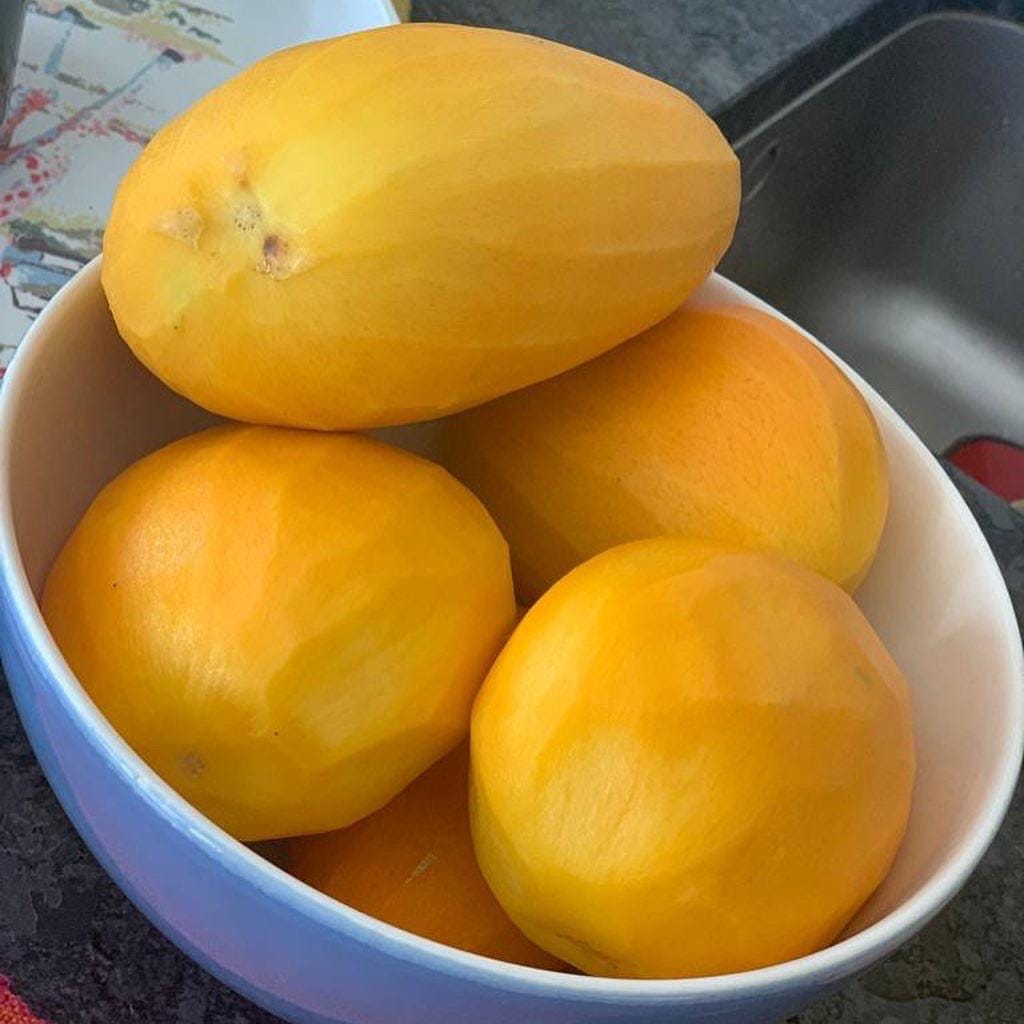
During Amma’s trip to Kerala in April, she devised a morning routine. She would be up every morning at 6 am to take a morning stroll around the large garden surrounding the house. Bag in hand, she collected ripe mangoes from the tree and rescued the ones that may have fallen overnight. Setting the mangoes down, Amma busied herself with breakfast preparations, ever the one to delay her own gratification. Midmorning, during a brief respite, she settled down on the porch and tended to the mangoes, knife in hand and no chopping board in sight. The mango rested in the palm of Amma’s hand, and she rotated it methodically as she sliced off more and more of the skin. The knife never missed its mark. My Gran sat nearby watching the traffic grumble past on National Highway 47, a mere few meters in front of their home. The roles may have reversed now but piece by piece, they ate Ottu mangoes together, as they might have done some forty-odd years ago.

Totally agree about the person who peels getting the right over gnawing the seed! How I dream to see the garden to wander around gathering mangoes!! Beautiful images, like in our mememories...
Loved reading this piece Anju! Been waiting for a quiet moment to read and savour!